Gait-Level Motion Design and Evaluation Framework for Grasp-Based Dynamic Locomotion in Microgravity
grasp-based locomotion
Abstract
Locomotion in microgravity often relies on sparsely and irregularly arranged anchors, motivating grasp-based mobility with multiple limbs. In this setting, dynamic traversal requires consecutive anchored interactions under coupled dynamic and kinematic constraints, yet the effects of gait-level motion design on locomotion feasibility and performance remain insufficiently understood. This paper formulates the feasibility and performance objectives for grasp-based dynamic locomotion and develops a gait-level parameter-metric framework that relates motion parameters to corresponding evaluation metrics. A physics-based simulation study instantiates the framework across two quadruped morphologies in randomized three-dimensional anchor environments. Controlled variations in gait-level parameters reveal broadly consistent effects on contact support, motion-induced loading, kinematic feasibility, actuation demand, and traversal time across the two robot realizations. These findings suggest that the investigated gait-level parameters provide an interpretable basis for analyzing feasibility and performance trade-offs.
Selected Publications
Research Objectives
- Identify the physical constraints and performance objectives for locomotion in migcrogravity
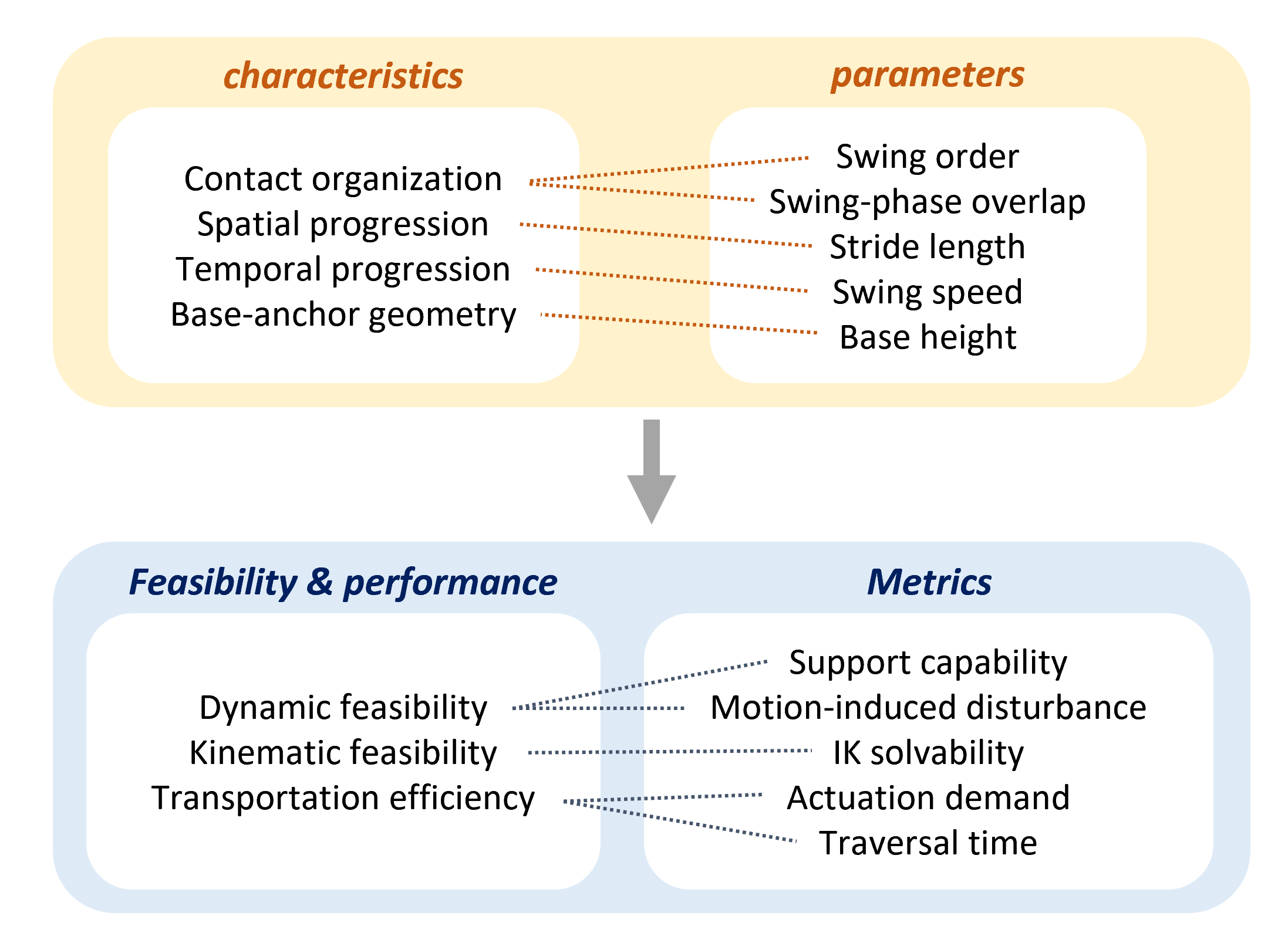
- Define gait-level design parameters and objective-driven metrics
- Validate the parameter-metric framework in terms of realizability, trend consistency, and interpretability
Parameter-Metric Framework
Without gravity, common terrestrial locomotion assumptions, such as support-polygon stability criteria and pendulum-based walking templates, are no longer directly applicable. Microgravity locomotion therefore requires a new definition of feasibility based on anchored contact interactions.
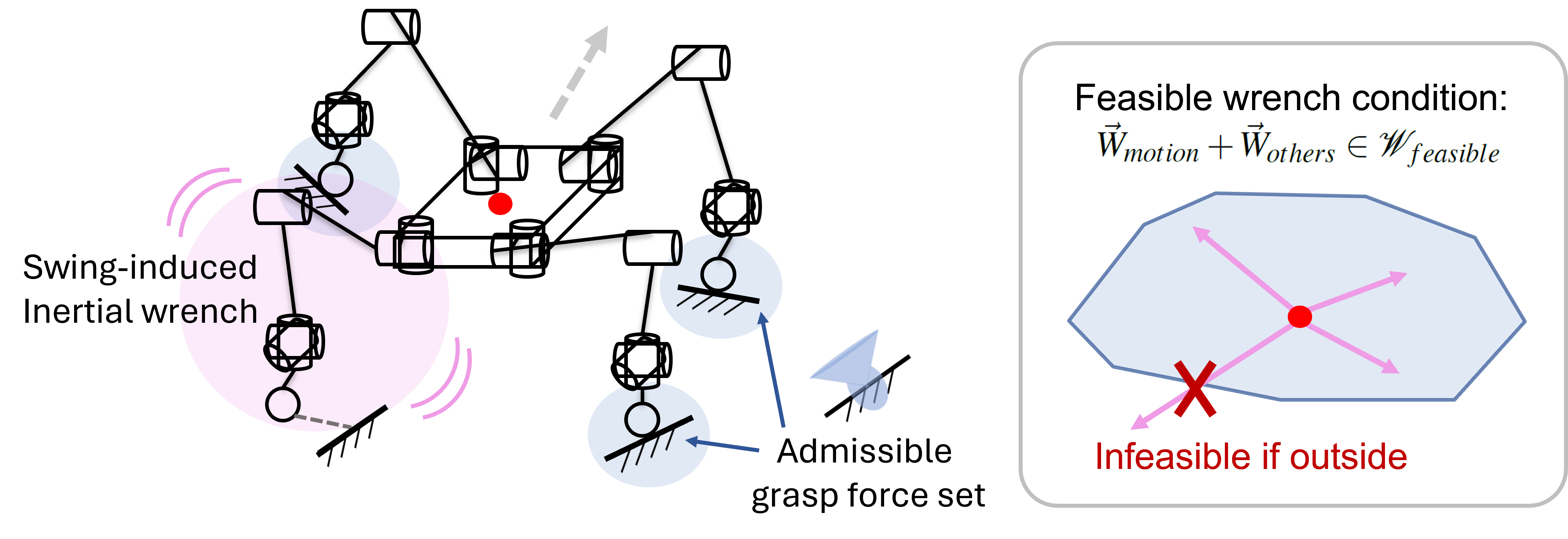
The framework relates gait-level parameters and metrics that assess feasibility constraints and performance objectives.
Simulation
The proposed gait-level parameter-metric framework is realized within a complete motion-generation pipeline.
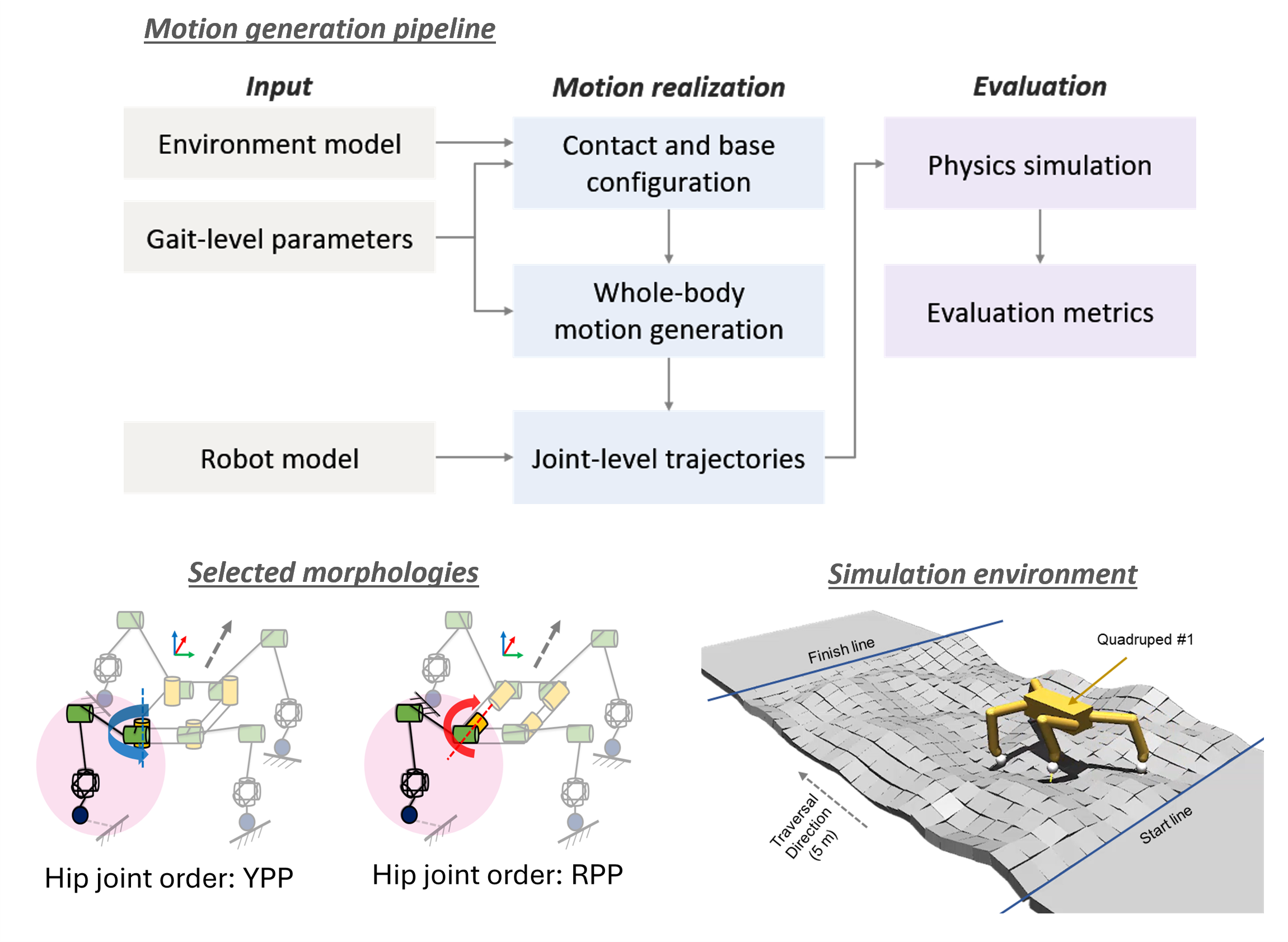
The framework is evaluated for a 5-m forward traversal, across 100 randomized microgravity environments for two quadruped morphologies (i.e., insect-like and animal-like). The selected morphologies differ in the proximal joint-axis configuration while sharing an identical distal chain. The simulation study compares one-at-a-time gait-level parameter variations against the reference gait.
Results
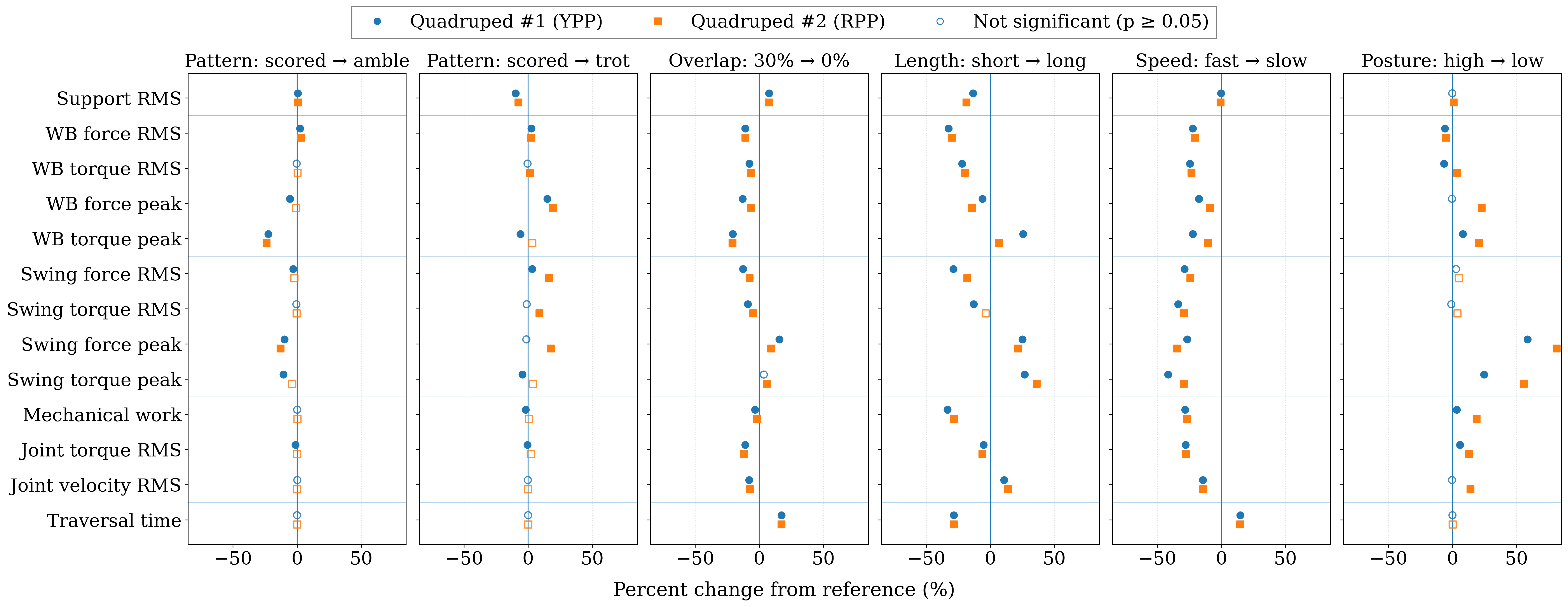
Although no individual parameter variation consistently improved all the evaluation metrics considered, some conditions resulted in more favorable overall outcomes under the investigated settings. The selected gait pattern outperformed trot, while its performance was not significantly different from amble. Removing swing-phase overlap and increasing stride length were generally beneficial, although both involved trade-offs in motion-induced peak wrench, and removing swing-phase overlap additionally increased traversal time. Similarly, a slower travel speed reduced motion-induced wrenches and actuation demands at the cost of longer traversal time. For the selected morphologies, a higher base height was preferable to avoid kinematically ill-conditioned states.
Conclusion
This study presents a gait-level framework for analyzing grasp-based dynamic locomotion in microgravity under coupled feasibility and performance considerations. The framework formulates the relevant locomotion objectives and relates gait-level motion parameters to quantitative evaluation metrics. Across randomized environments and two quadruped morphologies, the simulations revealed broadly consistent parameter–metric relationships despite morphology-dependent differences in absolute performance. These relationships exposed interpretable trade-offs among contact support, motion-induced loading, kinematic feasibility, actuation demand, and traversal time. The proposed framework therefore provides a systematic basis for comparing gait-level motion designs with respect to locomotion constraints and objectives. Future work will extend this framework toward condition-dependent parameter selection.
BibTeX
        @misc{moon2026motiondesigngraspbaseddynamic,
        title={Motion Design for Grasp-Based Dynamic Locomotion in Microgravity},
        author={Chaerim Moon and Joohyung Kim and Justin K. Yim},
        year={2026},
        eprint={2605.21704},
        archivePrefix={arXiv},
        primaryClass={cs.RO},
        url={https://arxiv.org/abs/2605.21704},